


Follow the latest news, legislative changes, updates to certification processes and other important information for applicants for conformity assessment of medical devices.
Science and research | Specialised AI Model for the MDR Domain
We are pleased to share that project FY01010118 – Specialised AI Model for the MDR Domain, in which the Czech Metrology Institute participates as another project participant, was recommended for funding under the 1st public call of the TWIST programme of the Ministry of Industry and Trade.

The aim of the project is to develop a specialised solution using advanced artificial intelligence methods in the regulatory domain of medical devices under the MDR. The tools being developed are intended to support work with regulatory requirements and technical documentation, both in its preparation by manufacturers and in processes related to its assessment by a notified body.
Congratulations to the project beneficiary, Kausabel s.r.o., as well as to another project participant, ING MEDICAL s.r.o., to the project investigators representing both of these entities and, last but not least, to the project investigator for CMI Medical, Ing. Petr Braťka, Ph.D.
For CMI Medical, participation in the project represents an opportunity to contribute actively to the development and verification of modern technologies applicable in regulatory practice. We are convinced that, once duly verified and appropriately implemented, the project results can significantly contribute to the quality, consistency and efficiency of the services provided to our customers.
CMI Medical takes a progressive approach to the adoption of modern technologies, but always in a controlled manner and in compliance with regulatory requirements. Their use in notified body activities must fully respect the requirements of the MDR, in particular Annex VII, and preserve the responsibility of the notified body, the professional judgement and competence of its personnel, impartiality, consistent and documented procedures, and the protection of confidential information. The requirements of Annex VII indeed impose on the notified body, inter alia, requirements concerning independence, impartiality, personnel competence and controlled procedures; MDCG additionally emphasises systematic management of risks to impartiality.
We therefore regard artificial intelligence technologies as a tool to support expert work – not as a replacement for it.
CMI Medical | Relationship between the CRA and medical device cybersecurity
With the approaching date of application of the first obligations under Cyber Resilience Act (CRA), manufacturers are increasingly asking us: Does the CRA also apply to medical devices containing software or other digital elements?
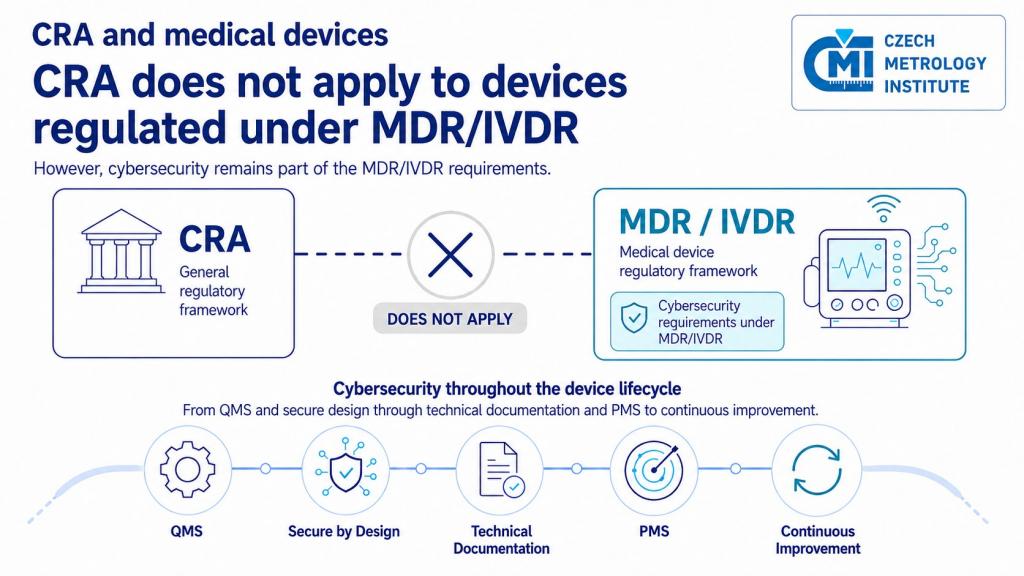
The answer regarding the scope of the CRA is clear. The CRA does not apply to products with digital elements to which Regulation (EU) 2017/745 on medical devices (MDR) or Regulation (EU) 2017/746 on in vitro diagnostic medical devices (IVDR) applies.
The topic is particularly timely because from 11 September 2026, the CRA reporting obligations concerning actively exploited vulnerabilities and severe security incidents will apply for products falling within its scope.
The exclusion of medical devices from the scope of the CRA does not, however, mean that cybersecurity requirements do not apply to them. For medical devices, these requirements form part of the sector-specific regulatory framework under the MDR or IVDR and, depending on the device, are reflected in particular in design and development, risk management, the quality management system, technical documentation and post-market activities.
For example, for devices incorporating electronic programmable systems and software, the MDR requires consideration of development lifecycle principles, risk management including information security, and verification and validation. Depending on the circumstances, the manufacturer must also address requirements relating to the IT environment, network interactions and protection against unauthorised access.
More detailed guidance on these requirements is provided in particular by MDCG 2019-16 Rev.1 – Guidance on Cybersecurity for medical devices.
Cybersecurity throughout the device lifecycle
Since April, we have been addressing this topic in our five-part series MDR CYBERSECURITY COMPLIANCE on CMI Medical on LinkedIn.
The series progressively focuses on:
- integrating cybersecurity into the QMS and risk management;
- principles of Secure by Design & Secure by Default;
- requirements for technical documentation and evidence of implemented measures;
- post-market surveillance, including new vulnerabilities and security updates;
- long-term maintenance and improvement of cybersecurity of the device.
Medical device cybersecurity is therefore neither a one-off task before certification nor a separate IT discipline. It forms part of the safety and performance of the device and must be appropriately managed throughout its lifecycle.
Would you like to keep up with more practical regulatory topics? Follow CMI Medical on LinkedIn.
Informative glossary of terms
CRA (Cyber Resilience Act) – Regulation (EU) 2024/2847 laying down horizontal cybersecurity requirements for products with digital elements. The CRA does not apply to products with digital elements to which the MDR or IVDR applies.
MDR / IVDR – Regulation (EU) 2017/745 on medical devices and Regulation (EU) 2017/746 on in vitro diagnostic medical devices. For relevant devices, they lay down, among other things, requirements relating to secure software development, risk management, information security and post-market surveillance. The MDR also considers software to be an active device.
Cybersecurity – in the context of the MDR, a set of measures to protect the device, its data and functions against relevant cyber threats. The MDR does not define this term separately; the requirements are reflected in particular in risk management, information security, design and development, and protection against unauthorised access.
Secure by Design & Secure by Default – principles according to which cybersecurity should be considered from the design stage and the device’s default configuration should be appropriately secure. The MDR does not use these English terms as standalone legal requirements; their substance is nevertheless reflected in requirements for risk management and secure design and development.
QMS (Quality Management System) – the system through which the manufacturer manages the processes necessary to ensure compliance with the MDR. Where relevant, cybersecurity should be integrated into the related processes, in particular design and development, risk management, change management, supplier management and post-market activities.
PMS (Post-Market Surveillance) – a systematic process of actively gathering and reviewing experience gained from devices after they have been placed on the market. In the cybersecurity context, where relevant, this also includes monitoring new vulnerabilities and security events and feeding them into risk management and any corrective actions. PMS is defined directly in Article 2(60) of the MDR.
More information for our customers is available on request or will be available in the customer information system (in preparation).

Expert seminar | MDR revision: key changes and sector readiness
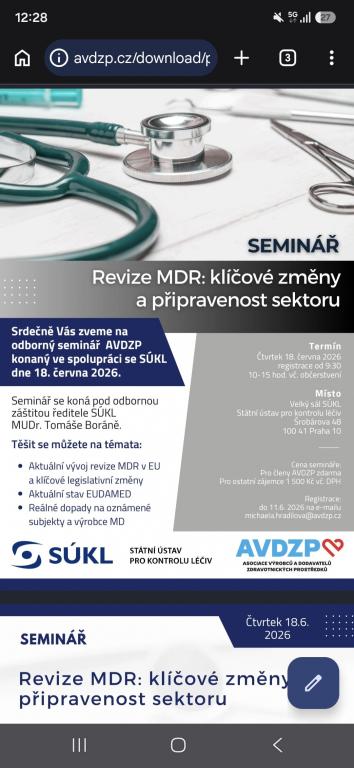
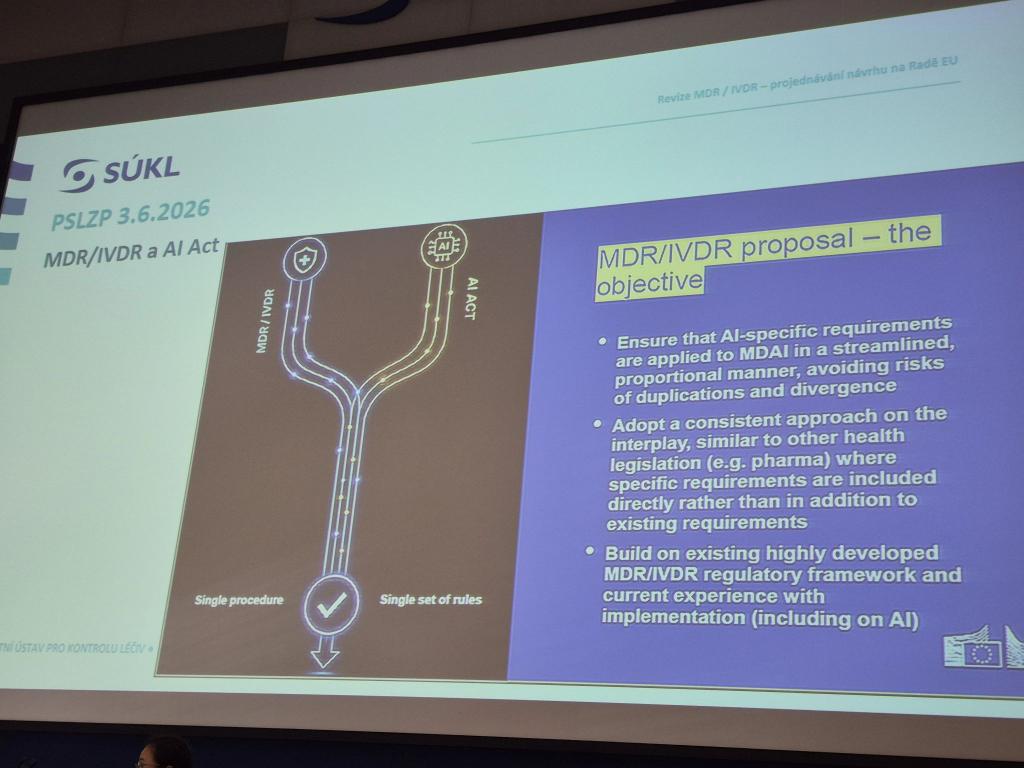
Today, CMI Medical sent a strong representation of our team to an expert seminar organised in cooperation with SÚKL on the topic: MDR revision: key changes and sector readiness.
The programme focuses on current developments in the revision of the MDR, the legislative direction in the EU and the practical impact on manufacturers and notified bodies, complemented by topics such as the implementation status of EUDAMED and the regulator’s and industry’s perspectives on the forthcoming changes.
We continuously monitor all relevant information sources and actively participate in expert discussions, particularly in the context of the forthcoming changes to the MDR. This enables us to keep our processes and approaches aligned with current developments and to continue providing notified body services at a high professional level.
We are pleased to be part of these discussions and to contribute to their professional development. We thank the Association of Manufacturers and Suppliers of Medical Devices and SÚKL for this initiative.
Image note: The Czech-language seminar programme shown in the gallery is titled “MDR revision: key changes and sector readiness” and states that the seminar was held on 18 June 2026 in cooperation with SÚKL.

CMI seminar | From theory to practice: How to conduct clinical investigations and successfully complete clinical evaluation
On 23 April 2025, CMI Medical held another expert seminar – and the main conference hall was completely full! We thank the speakers Helena Kolářová, Svatava Lagronová, Mirka Horáková, Marek Šmíd, Jan Kavalírek, Milan Škrdlet, Petr Matuška and Tomáš Kučera.






CMI seminar | From theory to practice: How to prepare an application and undergo an audit under the MDR
On Thursday, 26 September, a seminar for medical device manufacturers was held at CMI Medical in Prague-Chodov. The aim was to provide manufacturers with practical experience and recommendations on how to prepare for submitting an application for conformity assessment and undergoing an audit by a notified body.
Following opening remarks by Dr Ing. Marek Šmíd, Director for Fundamental Metrology, and Ing. Jana Vykoukalová, Chair of AVDZP, Mgr. Svatava Lagronová, Ph.D., a representative of the Czech Office for Standards, Metrology and Testing (ÚNMZ), gave a presentation on new regulations and guidance from the perspective of medical device manufacturers.
Speakers from CMI Medical included Ing. Jiří Šuráň, MBA, Director of CMI Medical; Mgr. Helena Kolářová, Deputy Director of CMI Medical; Ing. Jan Kavalírek, Head of the Contract Administration Department; and Ing. Petr Braťka, Ph.D., Preclinical Evaluation Manager and Project Leader.
The entire afternoon session was devoted to preparation for a notified body audit and was led by Ing. Martin Mayer, Ph.D., MHA, an auditor at CMI Medical.
More than 60 registered participants exceeded all expectations, making it necessary to move the seminar to a larger conference hall. The high attendance, together with positive feedback, demonstrates strong interest in the topics discussed and the value of organising expert seminars.
The CMI Medical team aims to be a reliable and fair partner for manufacturers during conformity assessment, which also means providing services of the highest possible quality.


Regulatory update | AI Act
On 12 July 2024, Regulation (EU) 2024/1689 of the European Parliament and of the Council, known as the AI Act, was published in the Official Journal of the European Union. The Regulation will enter into force on 2 August 2024, with its application being phased in over a period of three years.
Manufacturers of medical devices incorporating artificial intelligence should familiarise themselves with this Regulation and start preparing for its implementation so that they can fulfil all applicable requirements in time.
Basic requirements for AI products include, for example, correct classification into the new risk classes, implementation of a quality management system, maintenance of technical documentation and creation of event logs. The list of obligations for manufacturers is, however, much more extensive.
At CMI, we closely follow developments relating to this new Regulation and actively communicate with the relevant Czech authorities. We also have a team of artificial intelligence experts with extensive experience in this field who are ready to respond flexibly to the requirements of the new Regulation.
If you have any questions about the AI Act, please do not hesitate to contact us. We will be happy to assist you.
Science and research | Low-field magnetic MRI system
On 13–14 June, experts from several European countries (DE, IT, GB, FR, NL) met at CMI Medical to discuss a new low-field MRI system project. CMI Medical is responsible for preparing the technical documentation for the entire system, and our representatives are honoured to collaborate with so many international experts.
Regulatory update | MDCG 2021-24 Rev.1 (April 2026)
What has changed in medical device classification?
The Medical Device Coordination Group published MDCG 2021-24 Rev.1 (April 2026), updating its guidance on the classification of medical devices under the MDR.
While this revision does not change the legally binding classification rules laid down in Annex VIII to Regulation (EU) 2017/745, it significantly clarifies how these rules are expected to be applied in practice, including by notified bodies. The official revision overview lists, among other changes, an update to the definition of an implantable device, changes concerning the application of the classification rules, and amendments to Rules 8, 9, 10, 12, 16 and 22.
Why this matters
From a notified body perspective, the revised guidance:
- strengthens consistency and harmonisation of classification decisions,
- narrows the room for weakly substantiated “borderline” classifications,
- places stronger emphasis on clear justification of intended purpose and product qualification before classification,
- reinforces expectations for a well-documented classification rationale, particularly for active devices.
Intended purpose is fundamental to classification: according to the MDCG, the device class is determined by the intended purpose specified by the manufacturer, and where several rules or sub-rules apply, the strictest rule resulting in the highest classification applies.
Key areas affected
Without going into device-specific assessments, Rev.1 provides notable clarifications in particular in the following areas:
- Implantability – clarifies that a “clinical” procedure, not only a conventional surgical procedure, is relevant,
- Active devices (Rules 9, 10 and 12) – provides clearer examples and interpretation of risk-related criteria,
- Product qualification – especially at the interface between medical devices, accessories for a medical device and Annex XVI products (without an intended medical purpose),
- More targeted guidance for devices that may fall into a higher class (e.g. due to criteria leading to class III).
For implantable devices, Rev.1 expressly states that the term “clinical procedure” includes both surgical and non-surgical procedures; the revision overview describes this change as replacing the word “surgical” with “clinical”.
Important note
MDCG guidance documents are not legally binding. However, they are widely used as a reference framework for the expected regulatory interpretation in conformity assessment activities. Manufacturers should therefore ensure that their classification rationale is aligned not only with Annex VIII itself, but also with the current MDCG interpretative framework.
The MDCG document itself expressly states that its positions are not legally binding and that only the Court of Justice of the European Union can give binding interpretations of Union law.
Technical standards | Harmonised standards under the MDR: why the June update matters beyond the list itself
On 17 June 2026, Commission Implementing Decision (EU) 2026/1231 of 11 June 2026 was published in the Official Journal of the European Union, with new references to harmonised standards under Regulation (EU) 2017/745.
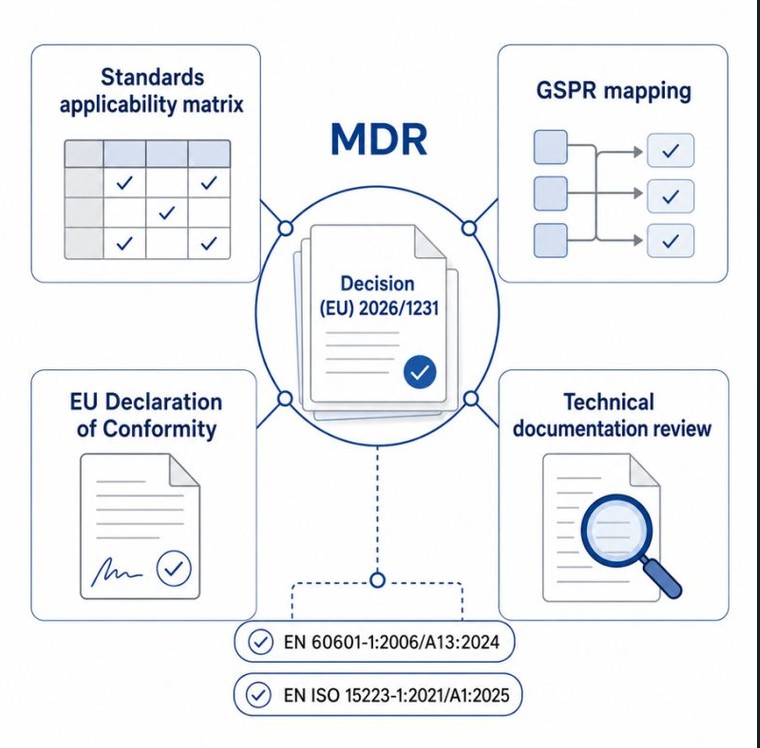
The update is notable not only because of individual standards such as EN 60601-1:2006/A13:2024 or EN ISO 15223-1:2021/A1:2025. From a notified body perspective, it is also a useful reminder of how harmonised standards interact with technical documentation, General Safety and Performance Requirements mapping (GSPR) and the EU declaration of conformity. For technical documentation review, this typically brings attention to several connected areas:
1) Standards applicability matrix
The standards list should not only identify standards used by the manufacturer. It should also distinguish between applicable, not applicable, partially applicable and superseded standards, with a documented rationale. A new OJEU reference may affect the reasoning behind why a standard is used, not used, or used only in part.
2) GSPR mapping
The key question is not simply whether a harmonised standard.
The key question is whether the technical documentation clearly explains which GSPR are addressed by the standard, which clauses are relied upon, and where additional evidence or justification is still needed.
This is particularly relevant where Annex Z or Annex ZZ mapping defines the relationship between the standard and specific MDR requirements.
3) EU declaration of conformity
Where harmonised standards are declared, the references should be consistent with the technical documentation and with the standards actually relied upon by the manufacturer.
4) Evidence in the technical documentation
A changed reference to a harmonised standard may also require checking whether existing evidence remains adequate.
From a notified body perspective, the most important question is often not whether a standard appears in a document, but whether its use is documented, current, justified and traceable across the technical documentation.
For completeness, the relevance of Decision (EU) 2026/1231 is broader than the two examples mentioned in this post.
The update also covers areas such as biological evaluation, symbols to be used with information to be supplied by the manufacturer, transfusion equipment, ophthalmic optics, non-active surgical implants, washer-disinfectors, prosthetics and sharps injury protection.
harmonised standards should not be read only as a list-management exercise. Depending on the device and the standards relied upon, they may also affect how evidence is traced across test reports, BEP/BER, labelling, instructions for use, packaging information, risk management links and performance-related evidence.
One specific example is EN ISO 15223-1:2021/A1:2025. The related Appendix to MDCG 2021-5 Rev. 1 addresses the transition from “EC REP” to “EU REP” and clarifies that this is an editorial / terminology update, not a change affecting the health, safety or performance characteristics of the device or the legal obligations of the authorised representative.
The broader point is therefore this:
Harmonised standards are part of the traceability chain between regulatory requirements, selected standards, documented rationale, objective evidence and the EU declaration of conformity.
Technical standards | Harmonisation of EN ISO 13485:2016/A11:2021
We recommend that manufacturers review their declarations of conformity and internal QMS documentation and ensure that references are made to the current harmonised versions of standards.
The updated list of harmonised standards provides manufacturers with legal certainty through the presumption of conformity with the General Safety and Performance Requirements (GSPR) laid down in the MDR.
Full details and the complete list can be found directly in the Official Journal publication.

Regulatory update | EUDAMED becomes the central database
This applies to you if you are:
- a manufacturer of medical devices or in vitro diagnostic medical devices
- a producer of systems or procedure packs
- an authorised representative
- an importer of medical devices into the EU market
EUDAMED is becoming the central database for medical devices and in vitro diagnostics. It collects information across the entire device lifecycle – from registration and certification through clinical evaluation to post-market surveillance.
Information on EUDAMED: https://webgate.ec.europa.eu/eudamed-help/en/welcome-to-the-eudamed-information-centre.html

CMI Medical | PF 2026
We wish you a peaceful holiday season free of non-conformities, and a New Year full of confidence, quality and the right decisions.
Czech Metrology Institute
PF 2026
CMI Medical | Extension of the scope of designation to include new MDR codes
The assessment followed CMI Medical’s application for an extension of the notified body’s scope of designation under the MDR and represents a key milestone in the overall process. The assessment identified several minor non-conformities, which are relatively straightforward to address.
A Corrective and Preventive Actions (CAPA) plan will be prepared without delay and the identified non-conformities will subsequently be resolved. It can be expected that the extension of the scope to include additional codes will be completed in the first half of 2026.
The application for extension covers the following codes:
- MDA 0303 - Active non-implantable devices using hyperthermia/hypothermia
- MDA 0304 - Active non-implantable devices for shock wave therapy (lithotripsy)
- MDA 0306 - Active non-implantable devices for extracorporeal circulation, administration or removal of substances, and hemapheresis
- MDA 0313 - Active non-implantable prostheses, rehabilitation devices, and devices for patient positioning and transport
- MDN 1201 - Non-active non-implantable devices for anaesthesia, emergency and intensive care
- MDN 1202 - Non-active non-implantable devices for administration, conduction and removal of substances, including dialysis devices
- MDN 1203 - Non-active non-implantable introducer catheters, balloon catheters, guidewires, introducers, filters and related instruments
- MDN 1204 - Non-active non-implantable devices for wound and skin care
- MDN 1213 - Non-active non-implantable devices composed of substances intended to be introduced into the human body via a body orifice or applied dermally
- MDS 1008 - Devices incorporating biologically active coatings and/or materials, or devices that are wholly or mainly absorbed or locally dispersed in the human body, or that undergo a chemical change in the body
In addition, the following special additional procedures:
- Conformity assessment procedure for certain class III and class IIb devices (clinical evaluation consultation procedure – CECP)
- Procedure for devices composed of substances or combinations of substances that are absorbed by or locally dispersed in the human body
Our sincere thanks go to everyone who contributed to the thorough preparation for or participation in this audit.

Trade fair | MEDICA 2025, Düsseldorf
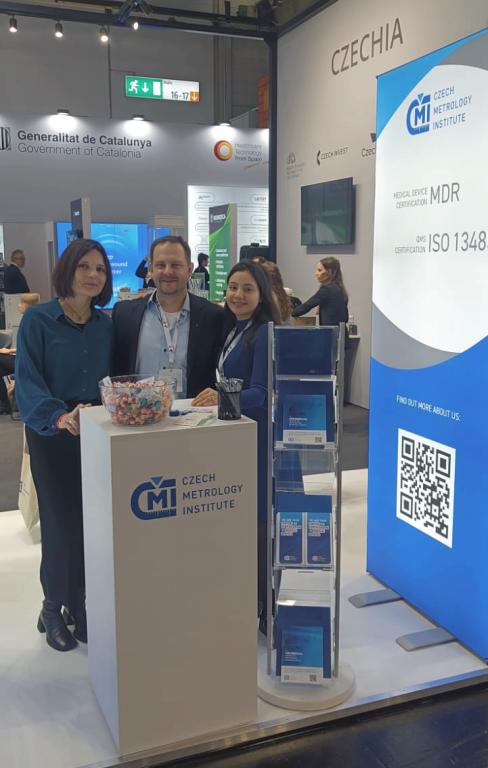
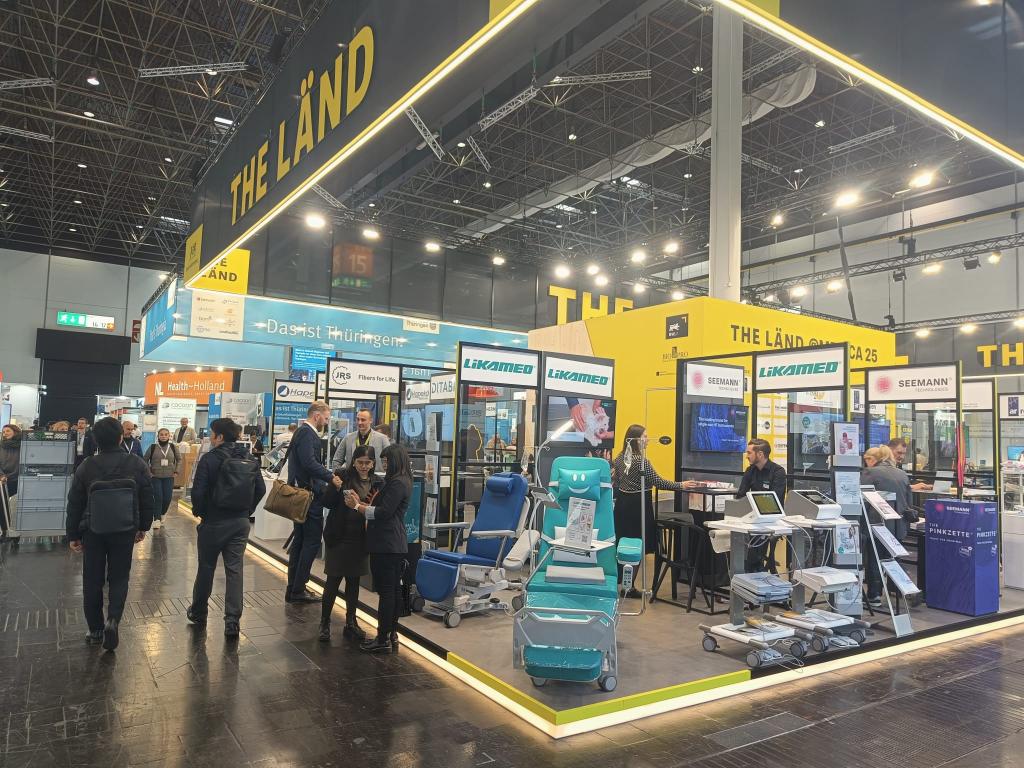
Under the auspices of the Czech Ministry of Industry and Trade, CMI Medical representatives attended one of the largest international trade fairs focused on medical technology and equipment, held annually in Düsseldorf, Germany.
We appreciate the considerable interest manufacturers showed in our services at MEDICA. Meetings with partners and new contacts confirm that the CMI Medical brand, despite our relatively short presence as a newly designated notified body for medical device certification under the MDR, already has a genuinely international reach.
Many thanks to the entire team for their excellent representation!
CMI seminar | From theory to practice: How to place medical software with AI on the market legally and safely
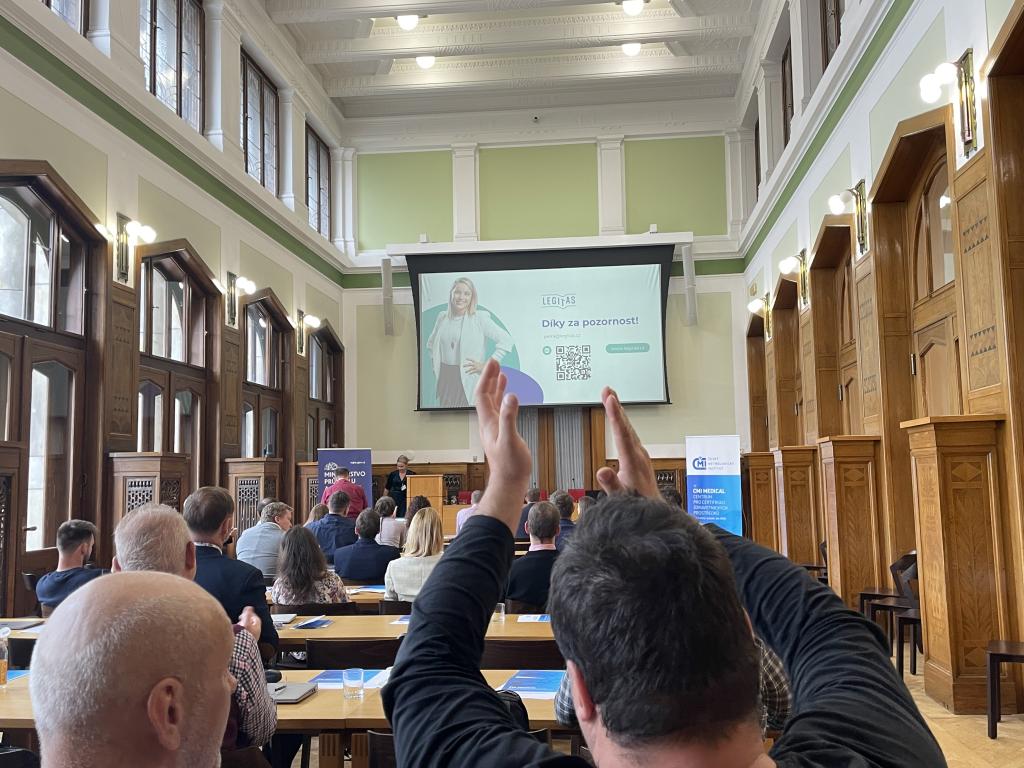
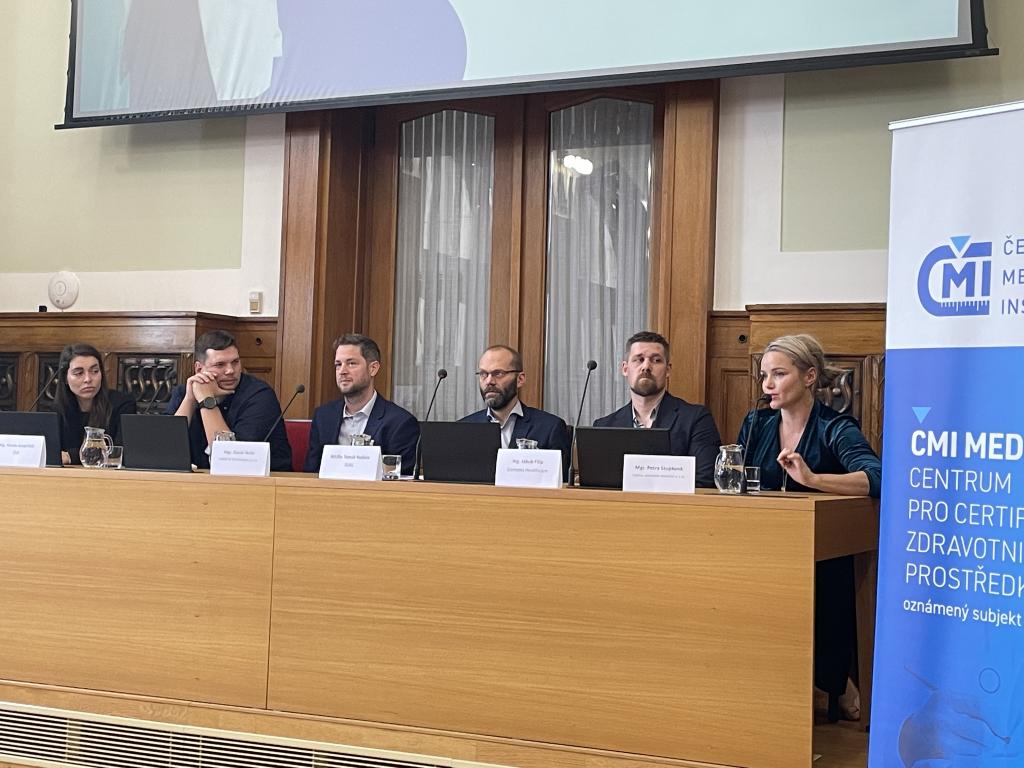
We thank the Ministry of Industry and Trade for its auspices of the seminar FROM THEORY TO PRACTICE: HOW TO PLACE MEDICAL SOFTWARE WITH AI ON THE MARKET LEGALLY AND SAFELY.
The strong attendance and active participation in the discussion confirmed that regulation of medical software incorporating AI is not only timely but also highly relevant. The discussion raised a number of interesting questions – and showed that not all of them have a clear-cut answer.
We also thank all speakers — Mgr. Helena Kolářová, Ing. Jan Kavalírek, Ing. Bc. Milan Škrdlet, MBA, Ing. Martin Koval, Ph.D., and MUDr. Tomáš Kučera — for their inspiring presentations, as well as Mgr. Petra Stupková of LEGITAS, Ing. Jozefína Vaľková of Aireen, Mgr. David Skála of Kardi Ai, and Ing. Jakub Filip and Roman Hanus of Siemens Healthcare for sharing valuable know-how and practical certification experience.
Special thanks also go to our colleague Ing. Miroslav Rosulek for organising and moderating the event.





Regulatory update | Extension of the MDR transitional period
Reasons for extending the transitional period
The MDR established high quality and safety requirements for medical devices and in vitro diagnostic medical devices. Particular emphasis is placed on oversight of notified bodies, conformity assessment procedures, risk management, vigilance, market surveillance, clinical evidence requirements, PMS, PMCF, transparency and traceability.
The original date of application of the MDR was postponed to 26/5/2021 due to the pandemic, and the end of the transitional period was set for 26/5/2024. However, due to insufficient overall notified body capacity in the EU and the resulting risk of shortages of medical devices on the market and a public health crisis, Regulation (EU) 2023/607 (an amendment to the MDR), amending Article 120 of the MDR, was ultimately adopted.
The amendment was subsequently accompanied by an explanatory Questions and Answers document (Revision 1 of July 2023), which describes the individual changes and the conditions for using the extended transitional period in greater detail.
Requirements for using the transitional period
This amendment extended the validity of all certificates issued under the MDD that were valid on 20/3/2023 (the date on which the Regulation was adopted). Manufacturers may therefore continue placing their medical devices on the market until the following dates:
- 31/12/2027 for class III and implantable class IIb medical devices
- 31/12/2028 for class I, class IIa and the remaining class IIb medical devices
but only if the following conditions are met:
- The medical devices continue to comply with the MDD
- No significant change may be made to the intended purpose or design of the medical devices
- The medical devices do not present an unacceptable risk to the health or safety of patients or other persons
and provided that the following actions are completed within the specified time limits:
- By 26/5/2024, the manufacturer implements a quality management system in accordance with Article 10(9) of the MDR
- By 26/5/2024, the manufacturer lodges a formal application for conformity assessment with a notified body
- By 26/9/2024, the manufacturer signs a written agreement on conformity assessment with the notified body
In addition to the above, since 26/5/2021 manufacturers have had to comply with the MDR provisions concerning post-market surveillance, market surveillance, vigilance, and registration of economic operators and devices. Surveillance of devices placed on the market under the MDD transfers, by 26/9/2024 at the latest, to the new notified body with which the manufacturer has signed a written agreement.
Removal of the sell-off date
Another change introduced by the amendment was the removal of the so-called sell-off date. Under the MDR, medical devices that had been lawfully placed on the market under the MDD could originally continue to be made available on the market only until 27/5/2025. The amendment removed this deadline, allowing medical devices lawfully placed on the market to continue to be made available on that market.
CMI Medical | CMI is a new notified body under the MDR
As of 22 December 2023, Czech Metrology Institute (CMI) has been designated as notified body No 1383 under Regulation (EU) 2017/745 (MDR).
Confirmation of CMI’s authorisation to operate as a notified body for conformity assessment of medical devices under the MDR, together with its scope (list of MDR codes), can be found in the European Commission’s Single Market Compliance Space database HERE or in the official confirmation document issued by the Czech Office for Standards, Metrology and Testing HERE.
No news items are available for the specified criteria.